

THE BASICS OF FINANCIAL AID
Understanding financial aid is a key part of the college admissions process. Financial aid helps families cover the cost of college through a combination of grants, scholarships, work-study, and loans.
1. FAFSA (Free Application for Federal Student Aid)
The FAFSA is the main form students must complete to be considered for federal, state, and institutional aid.
The FAFSA opens on October 1 each year (though for 2024–2025, it opened in December).
It determines your Expected Family Contribution (EFC) or Student Aid Index (SAI), which colleges use to calculate how much aid you may receive.
Students who are U.S. citizens or permanent residents are eligible to complete the FAFSA.
Let’s talk about the cost of college education and various financial aid opportunities available to you.
Financial Aid & Scholarships!
2. CSS Profile
Many private universities require an additional form—the CSS Profile—to assess financial need more comprehensively.
The College Board administers the CSS Profile.
It often asks for more detailed financial information than the FAFSA (and usually takes a lot longer to fill out)
It is used primarily to award institutional (college-based) aid.
3. Types of Financial Aid
Grants and Scholarships: Do not need to be repaid.
Work-Study: Provides part-time jobs to help students earn money during college.
Loans: Must be repaid, often after graduation.
4. Key Steps
Gather financial documents (tax returns, W-2s, etc.).
Submit the FAFSA and, if required, the CSS Profile before each college’s deadline.
Review your Student Aid Report (SAR) and correct any errors.
Compare Financial Aid Offers from colleges carefully.
Accept or decline aid based on your financial situation and loan responsibility.
5. Tips for Success
Apply early! Many programs have limited funds and operate on a first-come, first-served basis.
Check every college’s financial aid webpage for deadlines and requirements—they vary widely.
Ask questions: Colleges have financial aid officers available to guide you through the process.
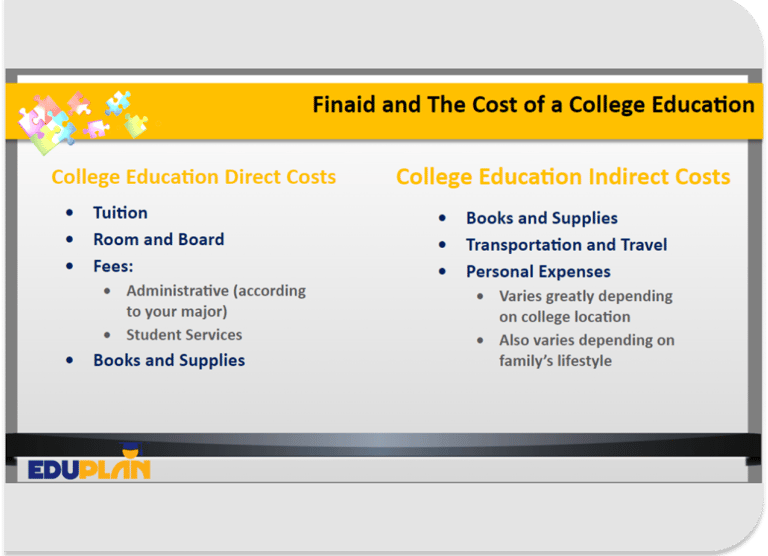
When compiling your college list, it is crucial to carefully consider the COST OF ATTENDANCE, which is equal to the sum of all direct and indirect costs of attending a college minus any scholarships and grants that you may be offered.

DETAILED INFORMATION
Please review our slide presentation HERE for a detailed overview of Financial Aid, Scholarships, and the Cost of Attendance. The presentation explains key concepts and steps to help you and your family plan effectively for college expenses.
From the slides shared above, you will learn:
Direct and Indirect Costs of College Attendance.
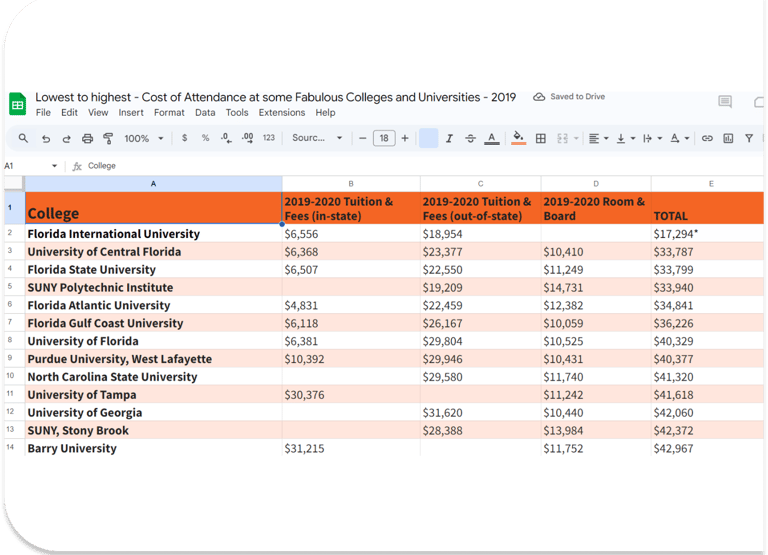
You can also review estimated costs of attendance at key colleges and universities [HERE], listed from lowest to highest.
Note: This data is provided as a general reference and may not reflect current tuition and fees. Use it only as a starting point for your college research.What Financial Aid Is and How It Helps Students Cover Educational Costs.
The Two Types of Financial Aid Applications:
FAFSA (Free Application for Federal Student Aid) – the main application for federal, state, and institutional aid.
CSS Profile – a more detailed form used by many private universities to award institutional aid.
Steps to Begin the Financial Aid Process and Eligibility Requirements.
What scholarships are and how to maximize opportunities for free college funding
The role of parents in improving a student’s chances of securing scholarships
Key terms in the financial aid and scholarship award letter
The importance of parent support and engagement throughout the financial aid and scholarship process
INTERNATIONAL STUDENTS
Understanding how financial aid works is essential for international students applying to U.S. universities. While there are many opportunities available, the process differs from that of U.S. citizens and permanent residents.
FAFSA and Eligibility
The Free Application for Federal Student Aid (FAFSA) is the main form used to apply for U.S. federal and state financial aid. However, FAFSA is only available to U.S. citizens and permanent residents (Green Card holders). International students are not eligible for U.S. government financial aid programs, including federal grants, loans, and work-study opportunities.


Institutional Financial Aid
Many universities offer their own institutional scholarships or grants to international students. These awards can be need-based, merit-based, or a combination of both. To be considered for this type of aid, international applicants typically need to complete the college’s own financial aid forms, such as the CSS Profile (used by many private universities) or an institution-specific application.
Certificate of Finances
Many universities also require the Certificate of Finances (COF) or a similar financial verification form.
This document, usually issued by the College Board or the university itself, must show that the student and their family have sufficient funds to cover educational and living expenses for at least one academic year. It’s an official part of both the admissions and visa documentation process. In addition, some might require a Bank Letter showing proof of funds in a U.S. account. Find a Template for your Proof of Funds Letter on our International Students page.
Key Takeaways
FAFSA is not available to international students.
Check each college’s website for its specific financial aid policy for international applicants.
Complete the CSS Profile or other required institutional forms by the published deadlines.
Submit the Certificate of Finances with accurate documentation of available funds.
Explore merit scholarships and external international awards (such as those from organizations like EducationUSA or private foundations).
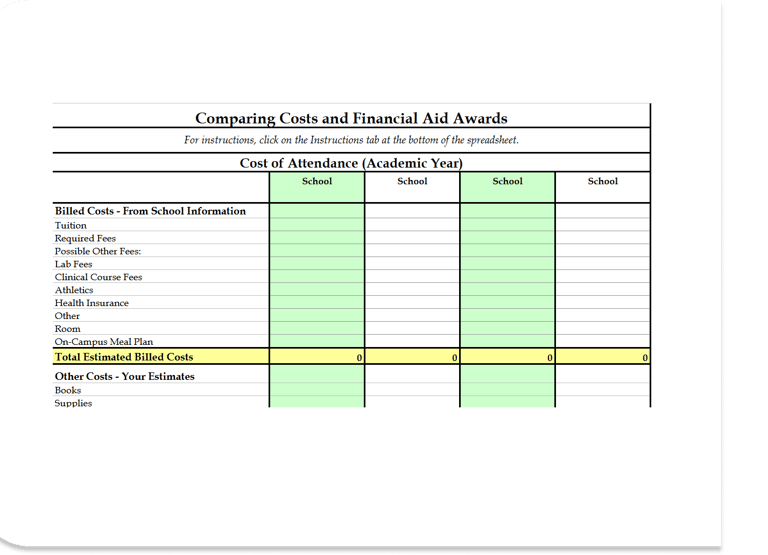
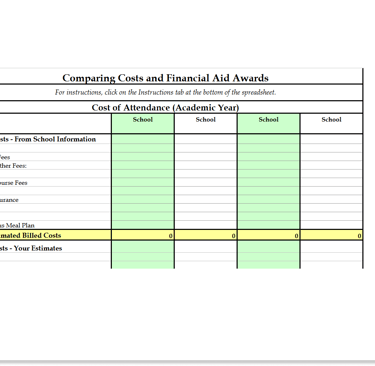
AWARD COMPARISON TOOL
HERE is a helpful tool to compare the cost of attending different colleges by bringing all expenses and financial aid into one clear view. To get started, enter your information in Sheet #2 of the tool using details from award letters, school publications, and official websites. Input each school’s full cost of attendance, including tuition, fees, housing, meals, transportation, and other academic-year expenses. Then add your financial aid information, such as grants, scholarships, work-study, and student loans (adjusted for applicable loan fees). The tool automatically calculates totals and shows how much of your costs are covered by financial aid versus the amount your family is expected to contribute.
This side-by-side comparison helps you assess borrowing needs, evaluate whether work-study expectations are realistic, and make a more informed decision about college affordability.