
Follow Up Presentation
Video presentation about the importance of following up with colleges after submitting your applications.
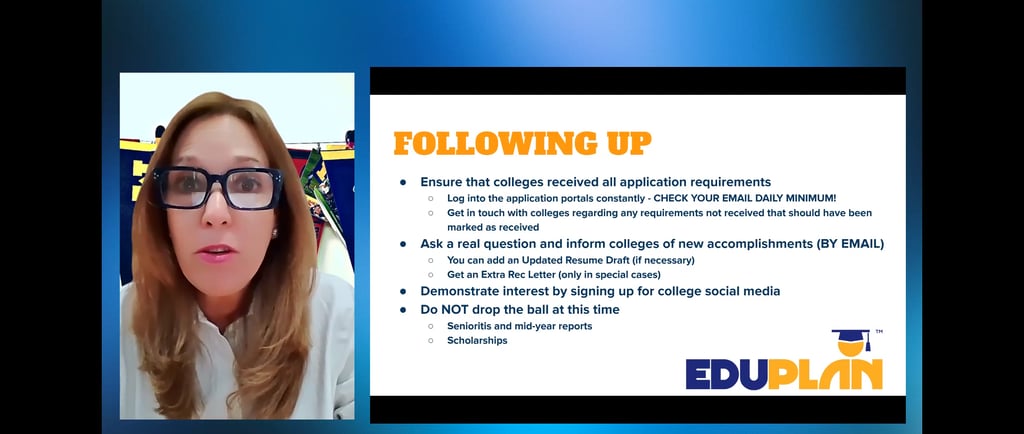
Smart Strategies for Following Up with Colleges
Overview of Key Themes
The presentation provides students with a strategic guide on how to effectively follow up with colleges after submitting their applications. Claudine emphasizes that this period is not for passive waiting but for proactive, thoughtful engagement. The core themes include maintaining a complete application, communicating new accomplishments, demonstrating continued interest, and avoiding common pitfalls that could jeopardize an applicant's chances. The talk stresses the importance of professionalism, personalization, and strategic timing in all communications with admissions offices.
Key Points
Ensure Application Completeness:
Students should regularly check their email (daily) and college application portals (2-3 times per week) to ensure all required documents have been received and their application is marked as 100% complete.
Promptly contact admissions offices to resolve any missing items.
Strategic Communication with Admissions Officers:
Send a follow-up email to the specific admissions officer responsible for your region. This communication provides an opportunity to share new accomplishments achieved since submitting your application (e.g., awards, leadership roles, or recognitions).
If you reach out, include a genuine and thoughtful question—one that cannot be easily answered by browsing the college’s website.
You may attach an updated résumé if it includes significant new information (at least two new achievements).
An additional letter of recommendation may be sent, but only if it comes from someone highly relevant (for example, a recent employer or a teacher connected to the university). Avoid sending excessive materials.
Demonstrate Continued Interest:
Follow colleges on their social media platforms (such as Instagram and Facebook) and engage with their online content.
Maintain strong academic performance. Senioritis can lead to declining grades, which is especially damaging for deferred applicants. The mid-year report should be as strong as possible.
Consider visiting the campus, especially if you are deferred or have not yet visited a top-choice school.
Avoid Critical Mistakes (The "Kiss of Death"):
The most serious error is sending a message to a college that includes another university’s name, mascot, or specific details. Such an error is considered highly disrespectful and almost always results in rejection.
To prevent mistakes, compose each follow-up email individually and space them out. Do not rely on a generic template for multiple schools. If you cannot ensure complete accuracy, it is better not to send the follow-up email at all.
Financial Aid and Scholarships:
This period is a good time to research institutional scholarships offered by the colleges you applied to.
Ensure that the FAFSA and CSS Profile have been submitted, as they are often required for merit-based aid.
Florida students should complete the Bright Futures application by the recommended deadline of November 15th.
Key Quotes
"Senioritis can mean that your grades will deflate, and then you might end up losing your chances to gain admission, especially if you get deferred."
"If the follow-up email has the name of another university or another officer or another mascot or another fight song, even, it can mean the kiss of death... This would be almost surely a direct denial for you."
"I'd rather you not send anything if you can't trust that you're going to do this very well because it could really ruin your chances entirely, whereas not sending a follow-up letter does not ruin your chances."
"Waitlist and deferrals are definitely not rejections... It's actually another opportunity to be reviewed."
"Do not open admissions decisions with friends. I highly encourage you to keep this process private. This is a moment where you do not want any judgment."
Action Points for Students
Audit Your Applications: Log in to all college portals this week to confirm every part of your application is marked as "received." Check your email daily for communications.
Identify New Accomplishments: Brainstorm any awards, new leadership positions, or significant achievements you have had since submitting your application.
Draft a Follow-Up Email: Prepare a personalized follow-up email for your top-choice schools. The ideal time to send this is between November 20th and November 28th. Use the templates on EduPlan.co for guidance but do not copy them verbatim.
Maintain Academic Excellence: Focus on your current classes to ensure your mid-year grades are as strong as possible. Avoid any drop in performance.
Thank Your Recommenders: Send a thank-you note to the teachers and counselors who wrote letters of recommendation on your behalf.
Complete Financial Aid Forms: If not already done, work with your parents to submit the FAFSA and CSS Profile as soon as possible.
Practice Discretion: Refrain from publishing admissions results on social media until you have made your final decision. Plan to open decision letters privately or with your family.
Go to our Following Up page on eduplan.co to access sample Follow-Up letters